WISH: World Innovation Summit for Health

Fancy using your planetarium for immersive remote surgery?

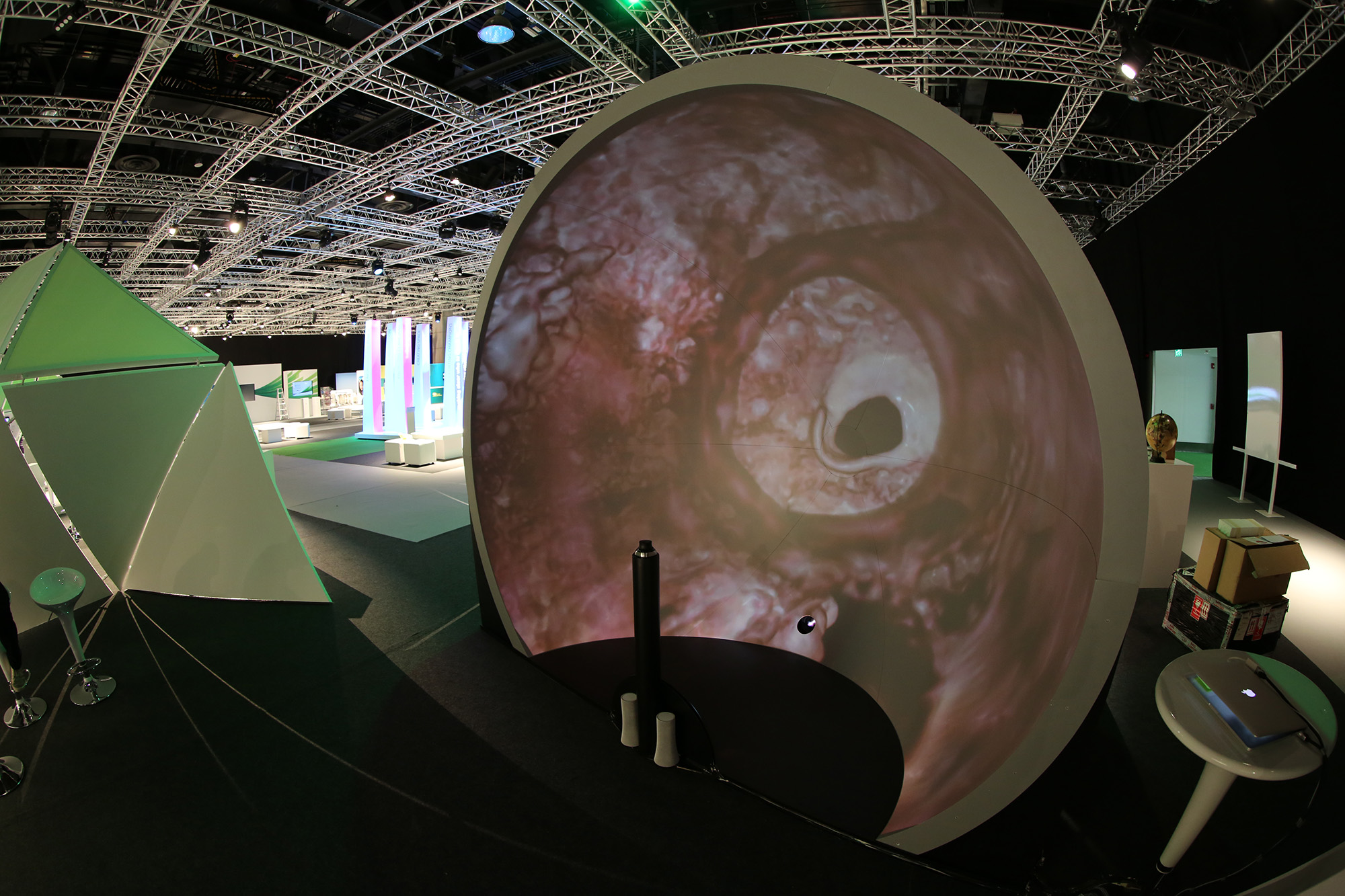
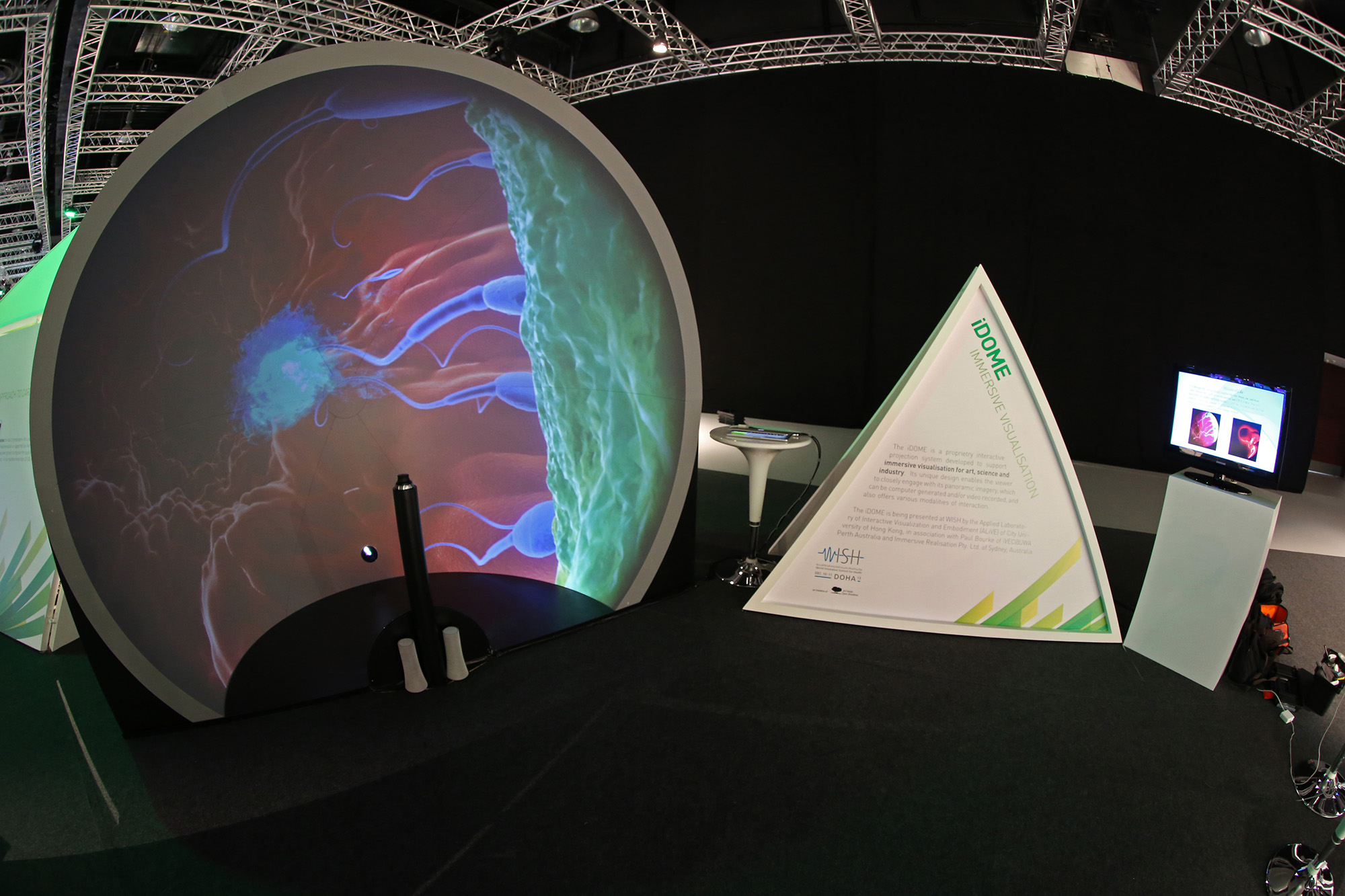
Just spent a week in Doha at the World Innovation Summit for Health. Besides being an amazing event I was commissioned to set up an iDome in the innovation hall. While I put together some content based upon medicine and biology, the main content was to demonstrate immersive remote surgery. One of the main organisers of the event (1000 delegates, invitation only) is the Imperial College of London where they have invented a surgical tool called the iKnife. In short it is an electric knife (i = intelligent) for surgery that extracts the smoke from the cut tissue and runs it through a mass spectrometer and tells the surgeon what type of tissue he/she is cutting through (healthy, cancerous for example). In short we demonstrated this at the conference, on a pretend patient of course … a selection of cow internal organs.

Image

Image

Posted in Uncategorized | Tagged | Leave a comment

A Night in the Museum

A Night in the Museum

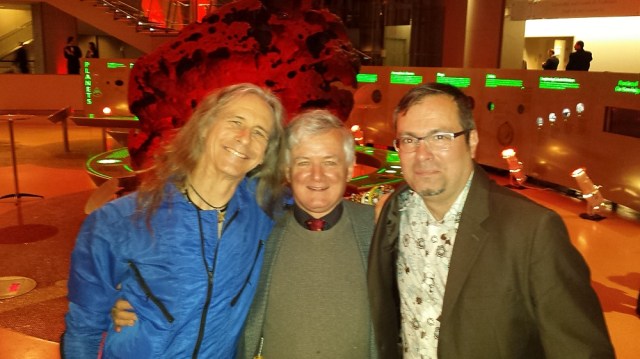
On my way to and from Gabon for the November 3rd total solar eclipse (successful), I went to the American Museum of Natural History (AMNH) several times, including their special night to launch the Hayden Planetarium’s latest show ‘Dark Universe’ on 28 October 2013. This is the third major AMNH special launch for shows or exhibitions I’ve managed to get to over the years.

Some of you would know the two fellows on either side of me after the official function – Carter Emmart (left) Director of Astrovisualization at the Hayden Planetarium and Ryan Wyatt, Director of the Morrison Planetarium and Science Visualization at the California Academy of Sciences in San Francisco. Always great to catch up. I went back the next night to watch Carter and Brian Abbott prepare and then present ‘Grand Tour of the Universe’ live using Digital Universe. It’s always great to spend time with Carter and last year the two of us literally spent hours into the night flying over and exploring the Moon and Mars in great topographic detail.

Mark Rigby

Posted in Uncategorized | Tagged | Leave a comment

Moon ready to receive Chinese lander

Moon ready to receive Chinese lander

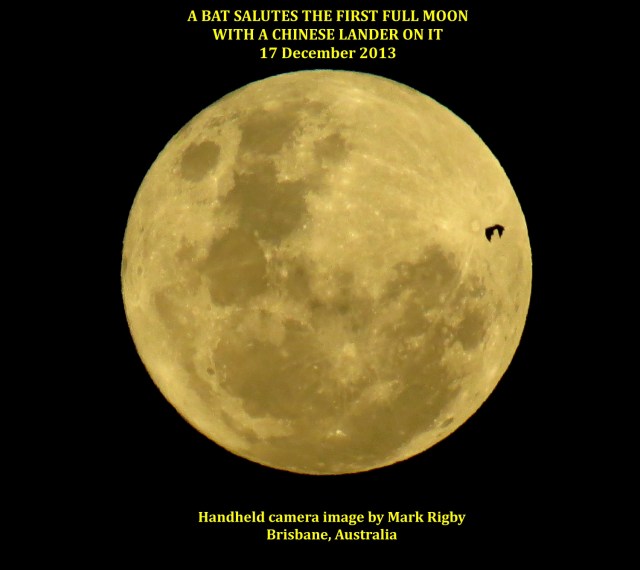
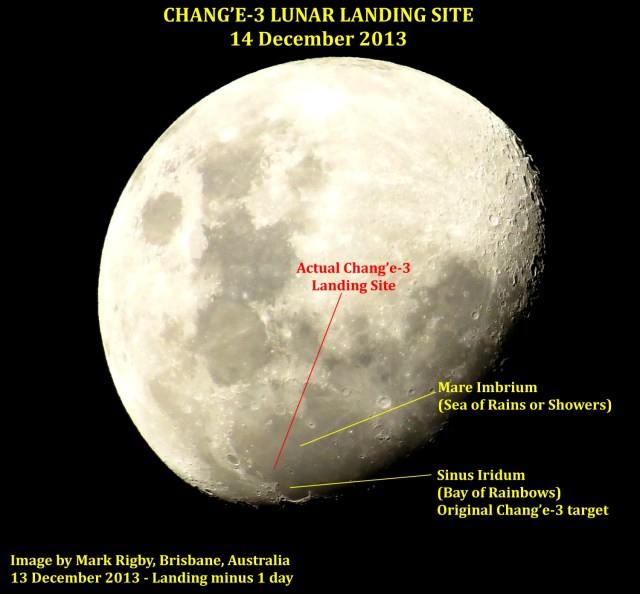
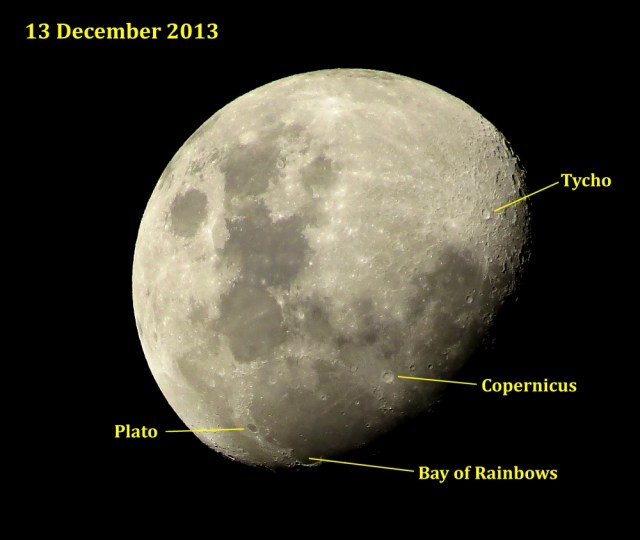
I took this handheld camera shot of the Moon last night from Brisbane. It was set at 50 times optical zoom on my Canon Powershot SX50 HS. The Chinese Chang’e-3 spacecraft makes its descent to the Bay of Rainbows tomorrow morning Brisbane time – a 700-second powered descent with 100 seconds of hover time 100m above the surface to select a smooth site. Then it drops the last 4m.

Mark Rigby

Posted in Uncategorized | Leave a comment

Inspiring Conference in Warsaw

*Posted by warikl on behalf of Martin George

One of the most worthwhile series of conferences I have attended have been the Communicating Astronomy to the Public conferences run by the International Astronomical Union.  Although have not been to them all, I found the 2007 conference in Greece and the 2011 conference in Beijing brilliant – so the 2013 event, held in Warsaw in October, was a must.  So, leaving the QVMAG Planetarium in Chris Arkless’  very capable hands, I headed over there.

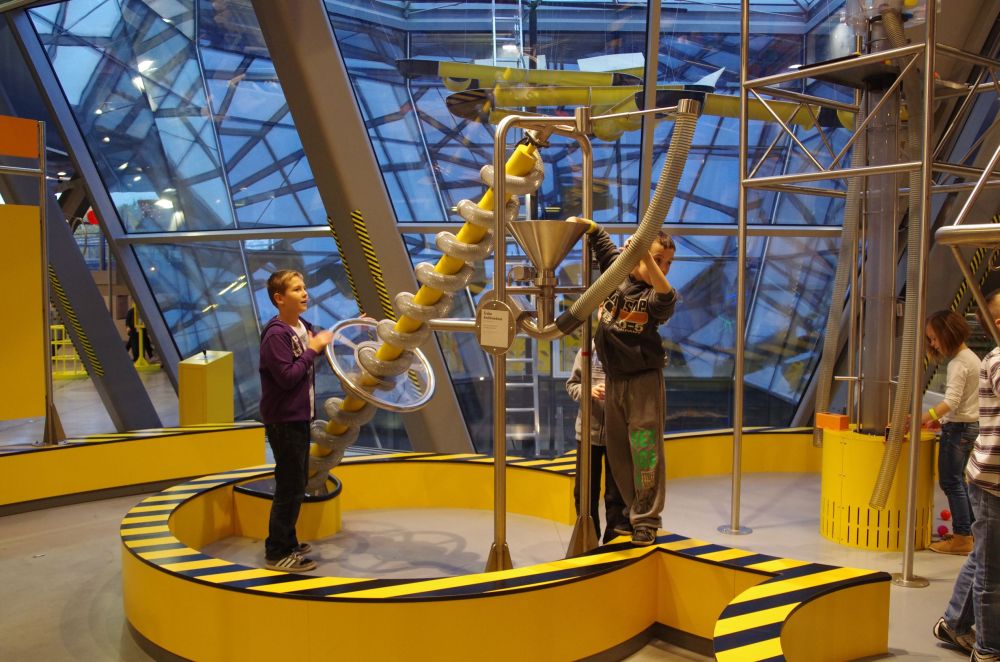
The main venue was the Copernicus Science Centre and Planetarium, a wonderful facility that has a quite extensive interactive science exhibit area.  This was certainly one of the several great points of interest for the week!
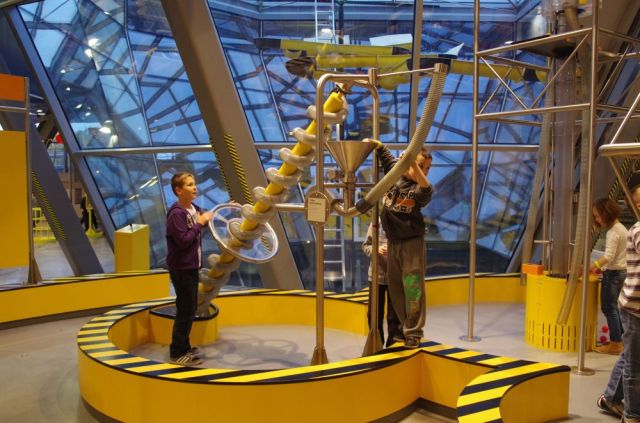
Children enjoying an interactive in the Copernicus Science Centre.  Photo Credit: Martin George

Children enjoying an interactive in the Copernicus Science Centre.
Photo Credit: Martin George

Of course, the most important aspect of the week was attending the many conference sessions, and my feeling, and the feeling of the attendees in general, was that they were all well worth attending, with excellent speakers.

There was a great deal of discussion about citizen science, in which people who do not necessarily have a scientific background participate in research projects that involve a lot of data – such as the classification of galaxies.  This method has a real place in scientific research.

I was particularly impressed with the talk by Lina Canas of Portugal.  She is passionate about bringing astronomy to vision-impaired people, and brought tactile star charts and models of the cratered lunar surface.

Another very important part of the week was a panel discussion about 2015 being the International Year of Light.  I saw this session as very important, because of the obvious strong connection with astronomy.  Among the panellists was Thomas Kraupe, President of the International Planetarium Society.  We discussed several aspects of bringing astronomy into the ILY, including the measurement of the speed of light using Jupiter’s moons, the measurements of starlight, using stars to measure the true rotation period of Earth, and other worthwhile projects.
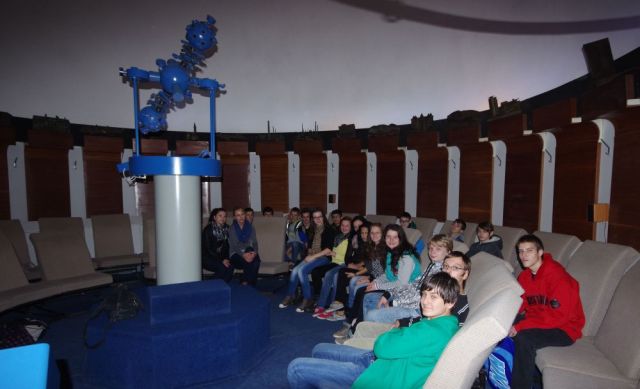
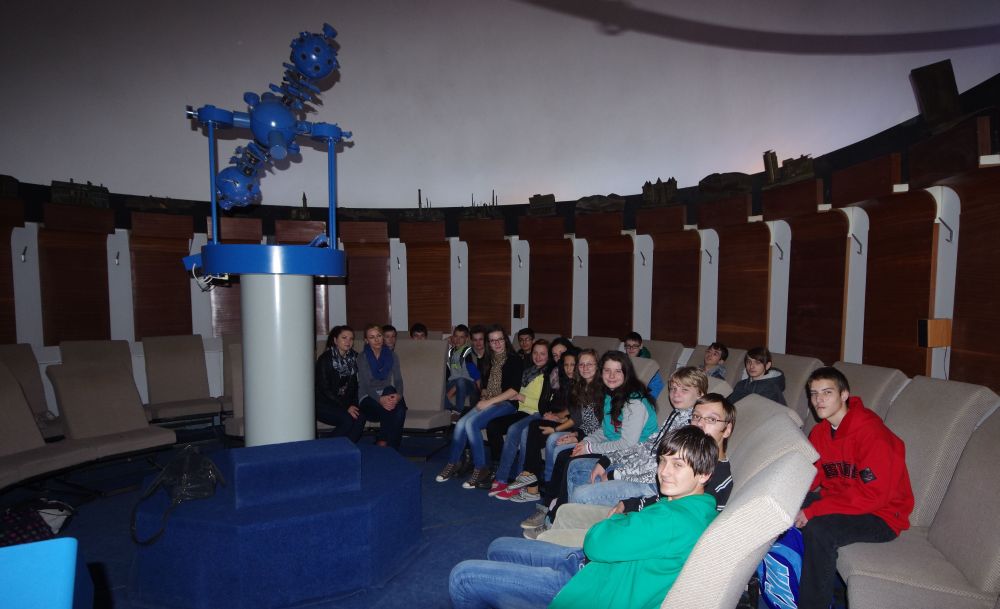
A group of students in the Planetarium at the Technical Museum in Kosice. Photo Credit: Martin George

A group of students in the Planetarium at the Technical Museum in Kosice.
Photo Credit: Martin George

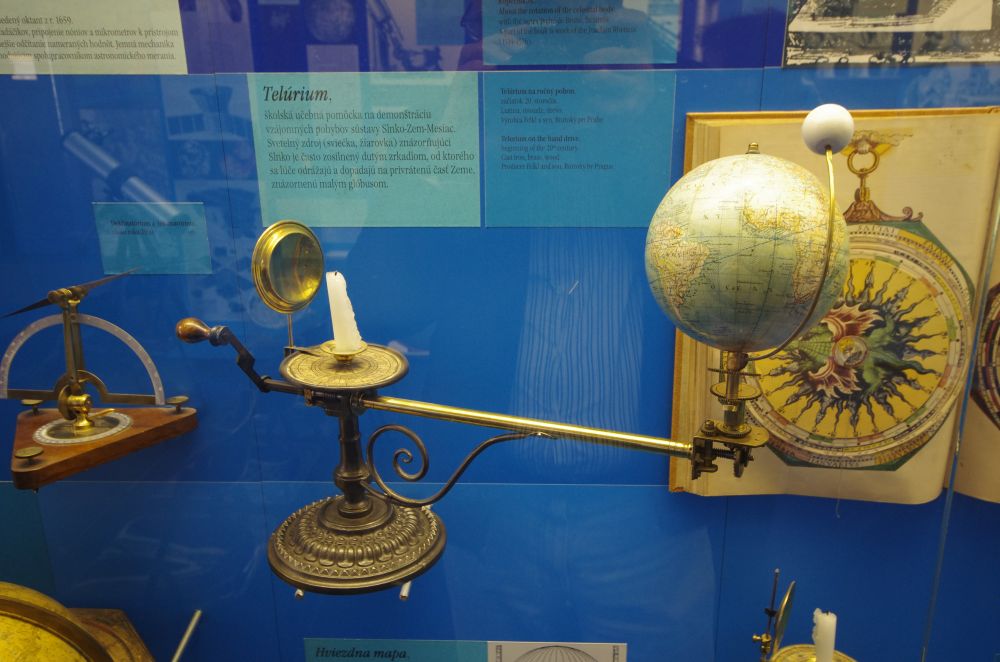
After the conference, I made a visit to Slovakia, in order to  make an official visit as IPS Chair of International Relations.  I chose Kosice, in the eastern part of the country.  The city has two planetariums; I spent a morning with the staff of the Technical Museum, which houses a planetarium with an 8-metre dome and a Zeiss ZKP1 projector.  Especially impressive was the collection of current and historical astronomical equipment on display.
Part of the excellent astronomy display in Kosice.  Photo Credit: Martin George

Part of the excellent astronomy display in Kosice.
Photo Credit: Martin George

As part of my IPS work, I am continuing to try to bring planetariums together in various parts of the world, and eastern Europe has long been a particular area of interest for me.  There are others, including the Arabic-speaking world.  I recently made a visit to the United Arab Emirates and had a very positive meeting at the planetarium at the Women’s College in Sharjah, but more about that another time!
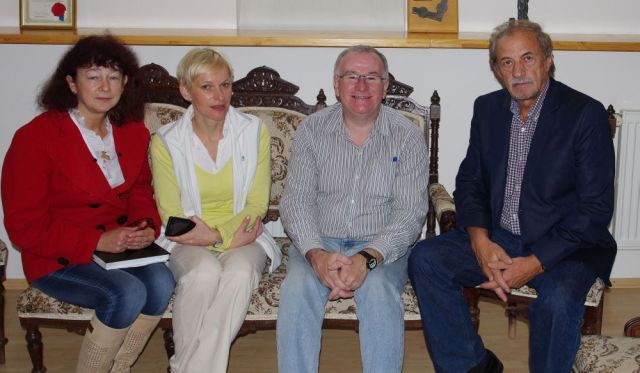
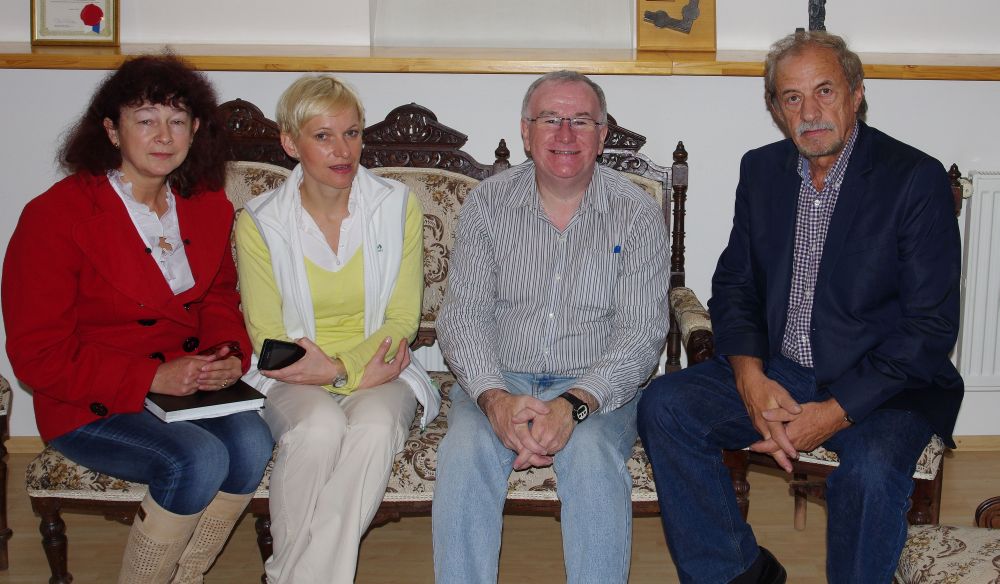
At the Technical Museum in Kosice.  Left to Right: Magdalena Semanova (Planetarium Manager), Zuzana Sullova (Deputy Director); Martin George (IPS Chair of Internaitonal Relations), and Eugen Labanic (Director)   Photo Credit: Technical Museum, Kosice

At the Technical Museum in Kosice. Left to Right: Magdalena Semanova (Planetarium Manager), Zuzana Sullova (Deputy Director); Martin George (IPS Chair of Internaitonal Relations), and Eugen Labanic (Director)
Photo Credit: Technical Museum, Kosice

Meanwhile, the QVMAG Planetarium in Launceston is continuing to run well, with Chris Arkless running the majority of the shows and providing much-needed and very welcome technical support.  November, as usual, was a big month for us for school groups, and the numbers of school group bookings are increasing every year.

Martin George
December 2013

Posted in Uncategorized | Tagged , , | Leave a comment

A visit to the Berlin Planetarium

*Posted by warikl on behalf of Monica Zetlin

Zeiss-Großplanetarium, Berlin

Zeiss-Großplanetarium, Berlin

During my September European Holiday, I squeezed in a quick visit to the Zeiss Grossplanetarium in Berlin where I caught up with the newly appointed Head of the Planetarium, Tim Florian Horn.
Opened in 1987, and located within the former East Berlin suburb of Prenzlauer, the Planetarium is a testament to Soviet-style architecture and aspirations. It is one of the largest stellar theatres in Europe, and incorporates not only a large (23m) planetarium theatre, but was envisaged as a cultural center with a restaurant, & a smaller conventional theatre.

Planetarium interior and Control Panel

Planetarium interior and Control Panel

The equipment was state of the art for its time, and the Planetarium building itself was built as just one part of a grander socialist dream, with residential buildings and a park surrounding it.
Under Tim’s leadership the Planetarium is about to undergo a major renovation and re-fit, starting from March 2014. While updating essential services such as fire safety and air conditioning, a brand new 165 degree dome will be installed. The dome will be built to avoid shadows when using the new star projector and a 6.5K fullome system. Visitors will also be treated to new seats, new ticket counter, and a brand new show.

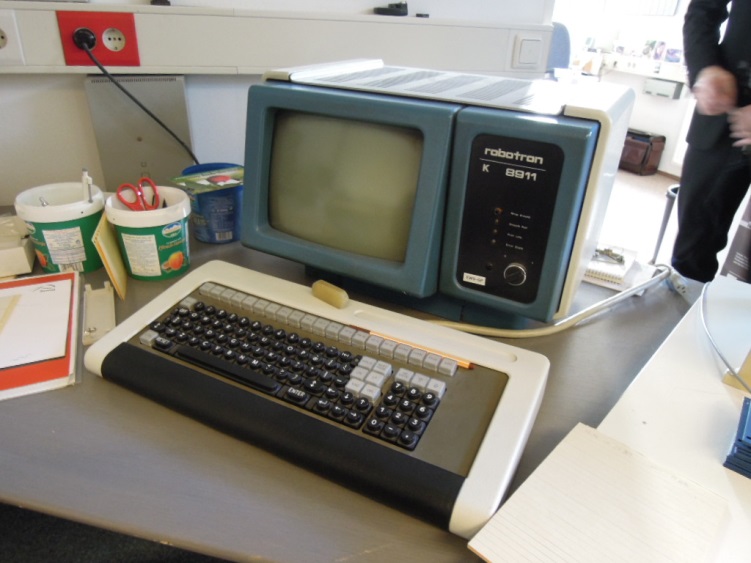
Don't lose the Robotron! Essential gear for any planetarium production suite.

Don’t lose the Robotron! Essential gear for any planetarium production suite.

Tim explained that it is still important to respect the original design and aesthetics of the building. Particularly in light of the Berlin tendency towards “Ostaglie” – a nostalgia for life under the socialist system of the former East Berlin. The plans are to keep the emphasis on the Planetarium as being a cultural center for much more than astronomy – indeed, it will be the new science theatre for the magnificent city of Berlin.

Tim holds the key presented to the first Head of the Planetarium when it opened in 1987

Tim holds the key presented to the first Head of the Planetarium when it opened in 1987

Good luck Tim – can’t wait to see the re-opening in 2015 of this grand venue. Hopefully some Australian content can feature!
Tim holds the key presented to the first Head of the Planetarium when it opened in 1987

Posted in Uncategorized | Tagged , | Leave a comment

Fill your head with Space!

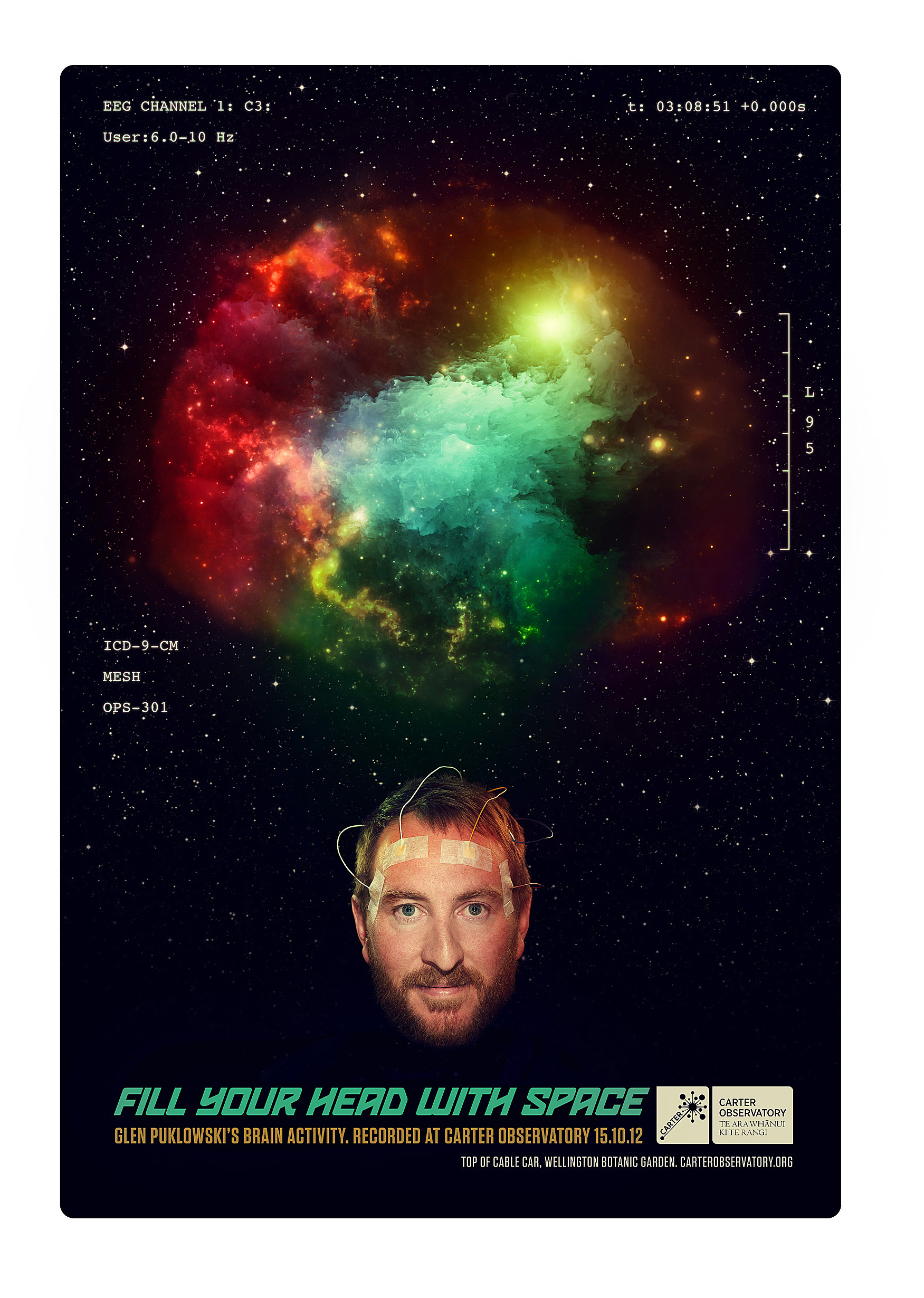
This year we have been focusing on getting a new audience to Carter. One way we have done this is by teaming up with Clemengers BBDO to create our “Fill your Head with Space Campaign” 

One of our challenges is keeping Carter Observatory front of mind. Signage showing visitors the way to Carter in the myriad of paths at the top of the Botanic Garden has also been an issue.

Carter Observatory wants to fill your head with space.

Take a bunch of people, put them in a state of the art planetarium, wire their heads up to Wellington Hospital’s high-tech EEG brain scanning machine, and turn on the stars. What do you get?

As Carter Observatory’s new advertising campaign illustrates, something quite extraordinary.

Brain wave of advertising agency Clemenger BBDO, the campaign aims to get more Wellingtonians visiting the observatory at the top of Wellington’s cable car. Says Clemenger’s Executive Creative Director Philip Andrew, “Carter is one of Wellington’s best attractions. But, as is often the case with the things in your own backyard, Wellingtonians forget it’s there. We wanted to get them excited enough to get up the hill.

It wasn’t too big of a stretch; anybody who watches the planetarium shows has their mind blown. We just had to think of a way to capture that.”

As suspected, the test subjects’ EEG scan results were remarkable. Stimulated brain activity showed up as colourful clouds strongly resembling the galaxies they were gazing up at.

Carter Observatory’s Marketing Manager Dawn Muir says, “It’s easy to forget the bigger picture in the business of our daily lives.  We know Carter offers a bit of relief from that, and inspires people to see their world a bit differently.  We want to share that message with Wellingtonians and visitors.

We are extremely grateful to Clemenger BBDO for their commitment to Wellington and their enthusiasm to help us out with this truly innovative campaign”.

We also want to acknowledge the wonderful EEG technicians at Wellington Hospital’s neurology unit.  Without their willingness to take precious time out of their very busy days, we wouldn’t have got there.  You guys rock!

We have been trying to add different events and public programmes recently, to show that our Observatory isn’t just about pure science. We have worked with photographers, science journalists and next year we will be taking our first step into the Wellington Writers Festival with Booker Prize winner Eleanor Catton, creating a Space themed Murder Mystery party, and adding some brand new planetarium shows.  All of these exciting events and marketing are helping us to be seen as an innovative and fun place to be that people will want to return to again and again.

Imagewww.carterobservatory.org/

Posted in Uncategorized | Tagged , , | 1 Comment

APS 2014 conference – First announcement

The dates for the APS 2014 conference have now been finalized.  The meeting will take place at the Melbourne Planetarium at Scienceworks on the 17th & 18th of February.  Following on from the APS meeting in Brisbane earlier this year, the conference will be taking place on a Monday and a Tuesday.  Hopefully this will allow those travelling from interstate or overseas the chance to arrive a few days early and enjoy the weekend in Melbourne.

Image: Museum Victoria

Image: Museum Victoria

This year we have also planned a pre-conference tour of the Great Melbourne Telescope which is currently being restored at Museum Victoria.  This tour will take place on Sunday the 16th of February from 2pm-4pm. Our guide for the tour will be Dr. Richard Gillespie author of The Great Melbourne Telescope.

Please make sure that you mark these dates in your calendar, as we are planning a jam packed conference.  And keep watching the blog for further announcements, details of the meeting and a few other surprises.

Posted in Uncategorized | Tagged , | Leave a comment

Stardome Upgrade October 2013 – Part Two

*Posted by warikl on behalf of the Stardome Observatory & Planetarium

StardomeReplacing a full rack of servers is not a simple task; many of the servers provide a direct feed to the projectors (four to each projector) through fibre optic cables. These cables have to be pulled and new cables laid for the new serer rack to connect to. By their very nature, fibre cables are fragile and care has to be taken to ensure that the cables are not placed under undue pressure or bent around to steep an angle. Once the new servers are in place, the show content from the old planetarium systems has to be copied across to the ten new servers, with approximately 1 terabyte of information per server required to be transferred.

With the new planetarium hardware in place the final physical component is the installation of the small cameras around the planetarium which will be used to provide an auto alignment of the two projectors, and also automatically adjust the blended image between the projectors to create an overall seamless image on the planetarium’s dome surface.

Behind the scenes, while all this work is happening, the planetarium dome will be cleaned and the audio system and speakers were tuned and reconditioned, effectively taking advantage of the closedown period to complete as many tasks as possible within the planetarium environment.

With the new planetarium hardware in place and the new Digistar 5 software installed, Stardome is will be in a position to take its audiences on new journeys of exploration throughout our solar system, Milky Way and through the known universe as a whole. The new software includes highly detailed planet terrains, with full 3d surfaces, enabling the presenters to not only fly up and orbit a planet, but to fly down and over the surface, through the canyons on Mars or around Olympus Mons. Stardome_terrain

The new earth textures provide a Google earth style of navigation with 3d terrain on the Earth as well, and live updates providing the ability to show live cloud cover and weather patterns.
But updated planet textures are not the only feature that comes with this new Digistar release, new datasets containing binary stars, variable stars and exoplanets, along with new sophisticated algorithms that allow astronomical bodies to maintain accurate positions and sizes across the enormous range of astronomical scales. There are new magnetic field lines which illustrate the movement of magnetic fields around the Earth and cross-sections of the Earth and Sun with animated interior textures. Stardome MarsThe upgrade also came with the “Science on a Sphere” datasets, allowing the presenters to show a virtual model of the Earth on the dome and change the surface textures to any one of those included in the new database, which covers topics on astronomy, atmosphere, land, models & simulations, and the ocean.
In the 3d modelling space the system now has the ability to do accurate rendering of volumetric data, which is useful for scientific visualisation, and for the re-creation of astronomical objects including galaxies and nebulae. The new Milky Way galaxy contains volumetric dust lanes, H2 regions and large scale cloud formations. It includes a number of volumetric nebulae developed by researchers from Stuttgart.
The upgrade will give Stardome the capability to entertain, inspire and educate audiences for years to come. Creating an environment that can meet the expectations of the various audiences that attend, be it public coming to learn about the night sky, schools on educational visits, or being taken on a journey of exploration through the universe, music shows with an enhanced visual experience, or corporates holding seminars of product launches under the dome.
The upgrade will only be possible through the support of the Regional Facilities Auckland, Sir Po-Shing Wo, Meridian, and the continued generous support of the ratepayers of Auckland. Stardome will truly become a dome for all disciplines.Stardome Auckland Council LogoStardome Regional logoStardome Meridian logo

Posted in Uncategorized | Tagged , , , | 1 Comment

Stardome Upgrade October 2013 – Part One

*Posted by warikl on behalf of the Stardome Observatory & Planetarium

Stardome

The planetarium industry is constantly evolving; new technologies are being developed to take audiences on more wondrous journeys, and providing presenters with the tools to develop rich stories and educational experiences. The digital planetarium at Stardome was installed just over five years ago, and the time had come for a refresh of the technology to ensure Stardome was able to continue to deliver world class astronomical and entertainment based programs. And so in October, 2014 Stardome will close its doors to the public for 10 days and begin the process of upgrading its systems and installing new features to enhance the overall audience experience. During the closedown period the exhibits, displays and telescopes were still open to the public, but behind the closed doors to the planetarium there will be a flurry of activity involving the installation of new lighting, new server hardware to run the planetarium, projectors are being refurbished, cables run and software updated.

Stardome Lighting The most noticeable of the new features to anyone walking into the planetarium, will have to be the new lighting system that is being installed to complement the already popular music shows. Ten towers positioned around the dome house new moving fixtures to add that rock concert element to the music shows. Imbedded behind the dome walls are also two high power lasers, set to fire over the heads of the audiences, creating additional effects to draw them into the overall music experience.

The lighting sequences are all controlled and time synced to the music and visuals on the planetarium thanks to some new lighting control software developed in New Zealand. The whole rig is being designed by theatrical lighting specialist Martin Searancke, whose lighting design credits include the hugely successful season of Miss Saigon at Auckland’s Civic Theatre; Martin also worked on the lighting design for Stardome’s production of War of the World’s last year.

But the new lighting is only one element of the overall upgrade that will be conducted during the closedown period. A key element within the planetarium is the two large Sony SRX-105 (SXRD) projectors. These ultra-high-resolution projectors were installed during the initial digital upgrade and had been running without a glitch for around 13,000 hours, so they are in need of an overhaul if they are to continue to operate into the future. Replacing the optical blocks within each projector will essentially be the same as putting in a new projector, effectively giving each projector a full recondition. Stardome E&S logo

However the core component to the planetarium would have to be the Evans and Sutherland Digistar software and hardware, which provides all the astronomical content, and allows for the playback of full dome show content. Since its initial installation with Digistar 3, Stardome has maintained an upgrade path with Evans and Sutherland, progressing to Digistar 4 when it came available as a software update a few years ago.

Stardome Digistar 5 logoWith the release of Digistar 5 and its powerful new astronomical features, Stardome is in need of not only a software upgrade, but a full hardware replacement to be able fully realise the capability of this new system. Driving the planetarium is a rack of 10 servers which are responsible for rendering the content out to the projectors as well as processing the 5.1 audio mix, and providing the presenters with a simple but powerful user interface. As the Digistar software evolved from release to release the new capabilities added more processing requirements on the existing hardware. By replacing the planetarium hardware Stardome has gained the ability to further enhance the audience experience through future software releases and the new features they may bring.

Posted in Uncategorized | Tagged , , , | Leave a comment

Imiloa Film Festival – Best of Awards

The Imiloa Film Festival has just finished – three great days of planetarium shows and fantastic conversations. Twenty-six shows were screened in total and the following four shows were awarded the best of the best.

Best Visuals – The Life of Trees (Softmachine)

Exploring why plants are so important to life on Earth.

Exploring why plants are so important to life on Earth.

Best Soundtrack/Narration – A Planet for Goldilocks (GOTO)

The search for a planet like Earth.

The search for a planet like Earth.

Best Script/Story – Dream to Fly (Copernicus Science Centre, Warsaw)

A poetic story about the history of aviation.

A poetic story about the history of aviation.

Best Overall – To Space and Back (Skyskan)

Discover how space exploration is shaping your world.

Discover how space exploration is shaping your world.

All four prize winners were very deserving and I look forward to sharing these shows with you at APS 2014 in Melbourne.

Many thanks to Shawn Laatsch and all the staff at Imiloa for a brilliant festival. Aloha!

Posted in Uncategorized | Tagged | Leave a comment