
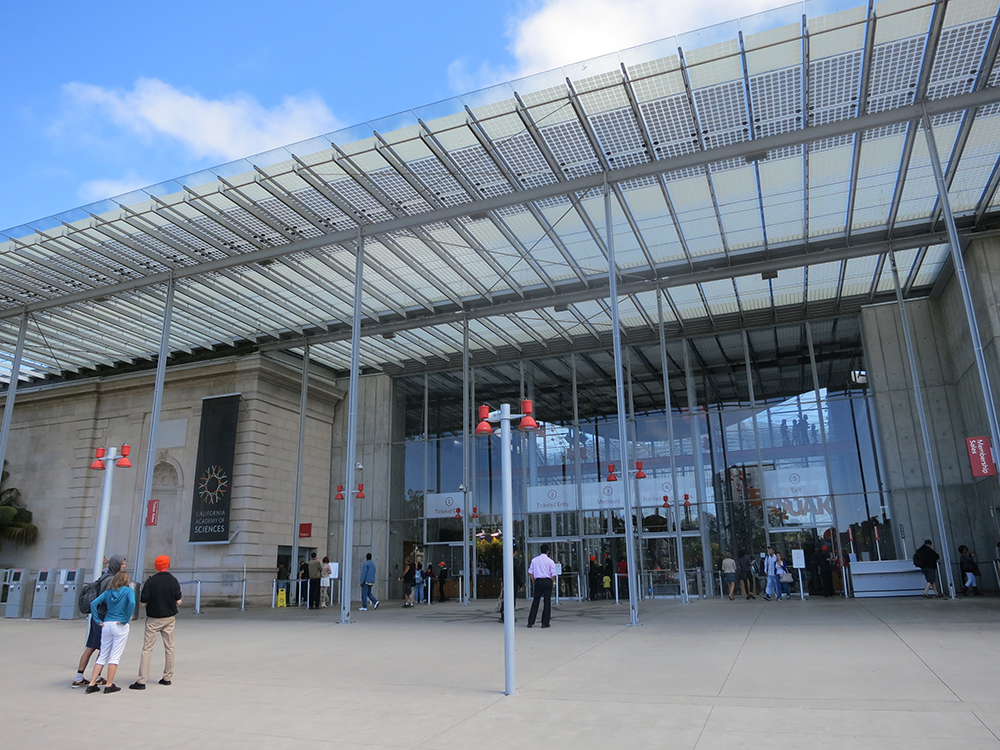
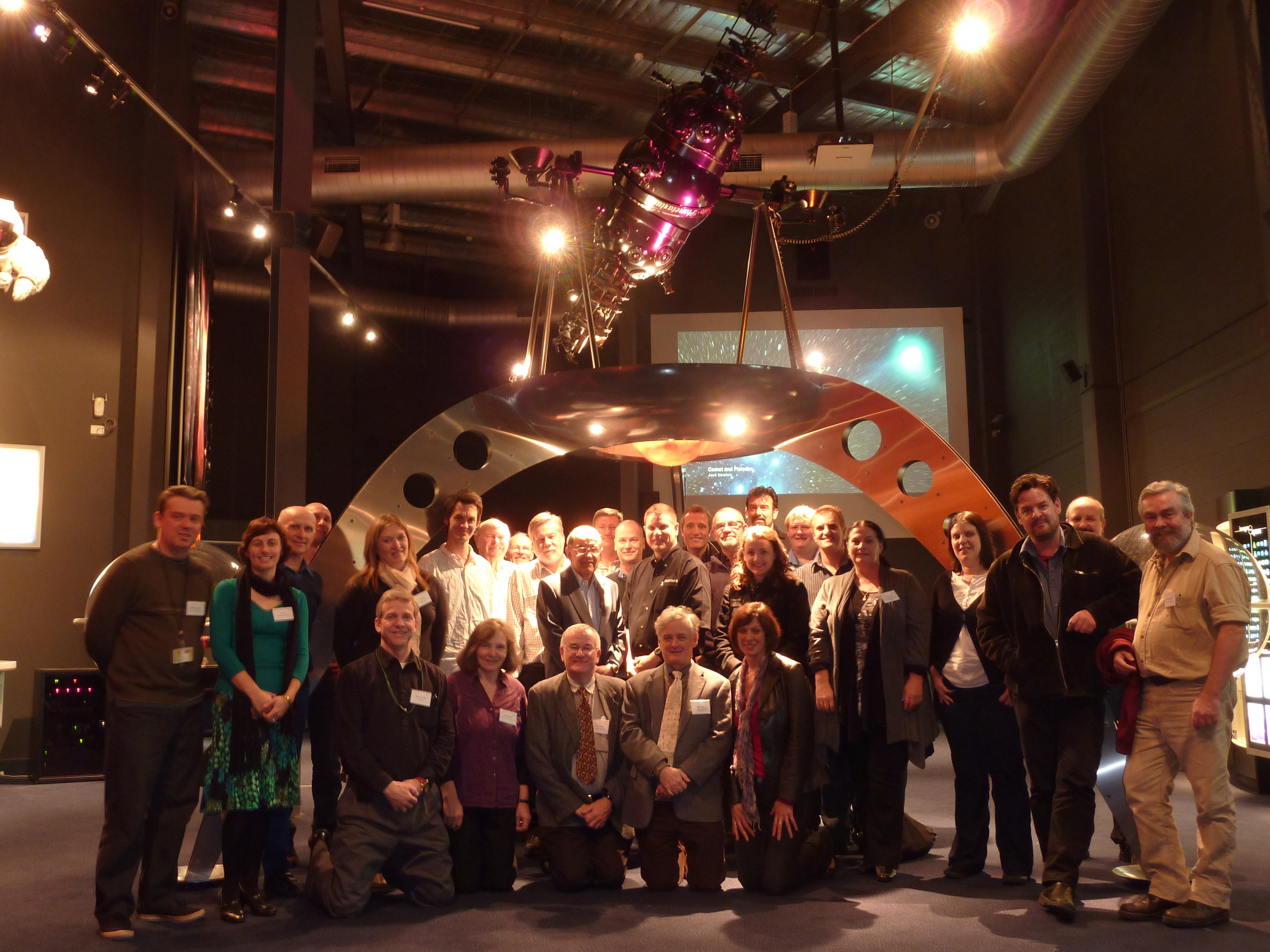
 On our recent trip to IPS, three of us from Museum Victoria, took the opportunity to stop over in San Francisco to visit the Morrison Planetarium at the California Academy of Sciences. One of the largest natural history museums in the world, the California Academy of Science was completely rebuilt in 2008 (the buildings were significantly damaged by an earthquake in 1989). The Morrison is one of the most pre-eminent planetariums in the United States, they produce their own planetarium shows and they have an extensive, state of the art, production facility.
As the Melbourne Planetarium is currently investigating a system upgrade, this proved a good opportunity for Dr. Tanya Hill (Astronomer), Andy Greenwood (Technical Services Manager) and Warik Lawrance (Production Designer) to gather information and forge a relationship with the team from the Morrison.
And it is a great team they have putting their productions together. For their latest show ‘Earthquake’ they had a production team of twenty, which includes three people who used to work for George Lucas’s company Industrial Light and Magic (ILM). This experience shows, as Earthquake is visually stunning, with an opening sequence that incredibly includes a complete reconstruction of San Francisco as it appeared in 1906. This sequence alone is worth the trip to the Museum.
We were fortunate to spend time with quite a few of the production team including Cheryl Vanderbilt (Production Coordinator), Tim Horn (Producer Climate & Earth Science Visualization), Tom Kennedy (Head of Production, Michael Garza (Planetarium & Production Engineering Manager)& Matt Blackwell (Technical Director). They were very gracious in showing us around the Museum as well as their production facilities. And they were very generous in sharing information on everything including operations, planetarium hardware, staffing models, production pipeline and more.
One of the great things about this stopover was that we had more people to run into at IPS. Here Tanya and I caught up with Tom Kennedy and Matt Blackwell for dinner at Stroubes Chophouse.
So if you have the opportunity to visit San Francisco, then make sure you include the Morrison Planetarium on your must see list.


Meta
- 8K
- Aboriginal
- Adelaide
- APS conference
- Armstrong
- ASTEN
- astronaut
- Auckland
- audio
- Barco
- Beijing
- Bendigo
- Berlin
- Brisbane
- camera
- Canada
- Carter Observatory
- Conference
- construction
- coral
- cosmodrome
- earthquake
- Education
- ESO
- festival
- film
- fisheye
- fulldome
- Fulldome filming
- Germany
- Hong Kong
- Imiloa Film Festival
- Indigenous
- IPS
- Italy
- Job
- kazakhstan
- Ladybug
- lunar eclipse
- macao
- Macau
- Melbourne
- Melbourne Planetarium
- merchandise
- Milan
- Moon
- morrison
- music
- New Zealand
- Observatory
- Orange
- Perth
- Pluto
- Projector
- RED
- san francisco
- science
- Siding Spring
- solar eclipse
- Solar System
- soyuz
- Stardome
- Sydney
- telescopes
- Tilt
- toy
- tycho
- Uluru
- upgrade
- USA
- wallworth
- Warsaw
- Wellington
- Wollongong
- zeiss
April 2026 M T W T F S S 1 2 3 4 5 6 7 8 9 10 11 12 13 14 15 16 17 18 19 20 21 22 23 24 25 26 27 28 29 30 -
Recent Posts
Archives
 Australasian Planetarium Society