Yuri’s Night

Yuri

Each April the world stops to mark the anniversary of Yuri Gagarin who in 1961, was the first human launched into space. This year Scienceworks and Melbourne Planetarium will play host to our first official Yuri’s Night Space Party on Friday the 22nd of April.

The night will include DJs. drinks, a talk from Mars One astronaut candidate Dianne McGrath, and  special planterium screenings of Dawn of the Space Age.

For more information head over to the Scienceworks website: https://museumvictoria.com.au/scienceworks/whats-on/yuris-night-space-party/

Posted in Uncategorized | Tagged , | Leave a comment

Sir Thomas Brisbane Special

Brisbane Presentation01

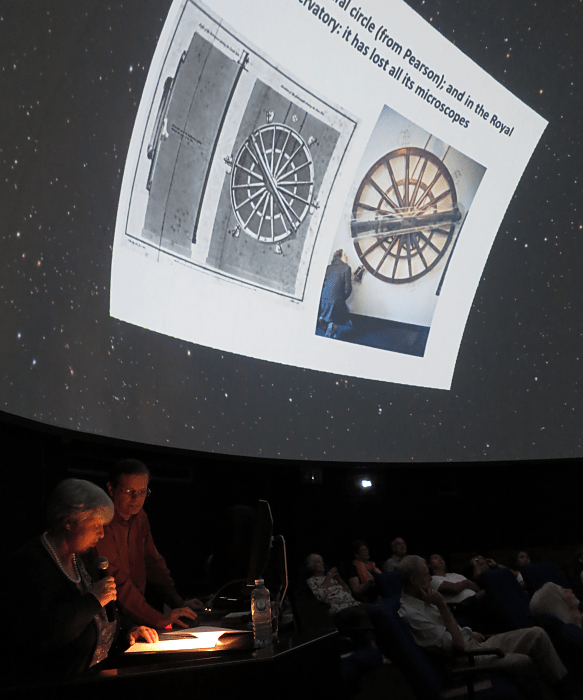
On Saturday, April 9, the Sir Thomas Brisbane Planetarium hosted a free public session entitled “The Soldier-Astronomer: Thomas Makdougall Brisbane’s Scientific Work.” It was presented by Alison Morrison-Low, who has recently retired as a History of Science Curator at the National Museums of Scotland and is now a Research Associate there. Alison is also a recipient of the Royal Scottish Society of Arts Brisbane Medal. We projected the presentation in three directions on the dome to cater for our concentric seating, while we had the stars visible from the latitude of Sir Thomas’s home in Largs, Scotland, drifting by slowly.

Brisbane talk1

Alison covered the life and work of Sir Thomas Brisbane, touching on his service in the British Army, his nearly being shipwrecked in the West Indies and consequently deciding to learn how to navigate by the stars, his observatories in Scotland and Australia and his influence on the scientific community in the 19th century. She also provided an update on plans to restore Sir Thomas Brisbane’s observatory, which has been cleared of overgrowth since I was in Largs in 2011.

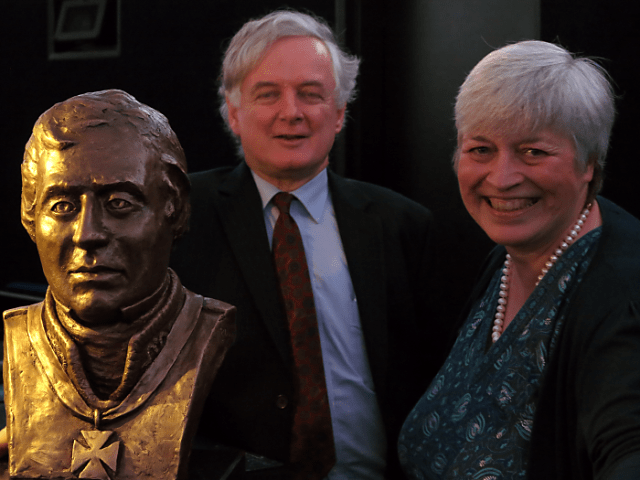
After Alison’s presentation, a just-completed bronze of Sir Thomas Brisbane was unveiled by Brisbane local physiotherapist and sculptor Peter Dornan. Peter had thought about doing a bust of Sir Thomas after he and his wife attended our Valentine’s Day special show last year and I related how one day I would like to see a full-size Sir Thomas outside the Planetarium. Peter completed two copies of the bust – one to keep and one may end up in Brisbane City Council’s City Hall.

Brisbane_Mark_Alison

Above: Sir Thomas Brisbane Planetarium Curator Mark Rigby and guest presenter Alison Morrison-Low with the bronze of Sir Thomas Brisbane completed this week. (Images here by Duncan Waldron.)

Brisbane_Dornan.png

Above: The bronze of Sir Thomas Brisbane with its creator Peter Dornan.

I still hope that one day, a statue of Sir Thomas will grace the lawn outside of the Sir Thomas Brisbane Planetarium to join our bronze of Konstantin Tsiolkovsky, Founder of Cosmonautics, which is extremely popular with visitors.

Mark Rigby

Posted in Uncategorized | 1 Comment

MCIC: Michael Crough Innovation Centre

DomeLab at the MCIC (Michael Crough Innovation Centre)
Shows during the Michael Crough Innovation Centre exhibition at UNSW

Posted in Uncategorized | Leave a comment

Look up Mumbai

Some photographs from “Look Up Mumbai”, an exhibition of DomeLab.

DomeLab is  the first ultra-high resolution (4K) experimental fulldome in Australia. It is a unique, low-cost display system integrating technical innovation in computing power and graphics capabilities with aesthetic innovation in content delivery. This project is a collaboration between 15 investigators from 11 organisations whose pioneering research is at the forefront of new media art, new museology and digital humanities.

Posted in Uncategorized | Leave a comment

Time to get your bags packed – APS 2016 is nearly here

APS2016

4-5 April

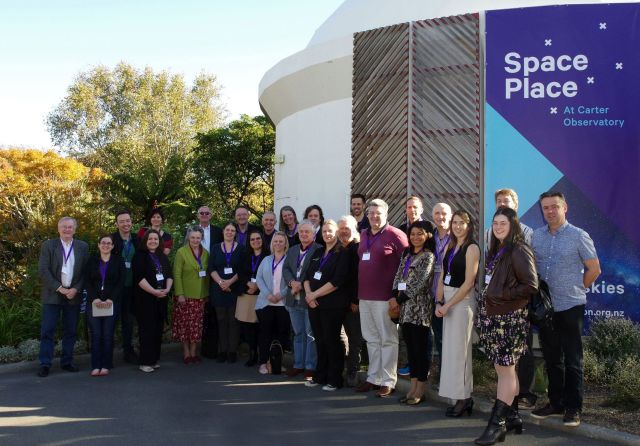
Space Place at Carter Observatory, Wellington, NZ

Milky Way Above Carter Observatory

The Milky Way hangs low over Carter Observatory late one night in Wellington, New Zealand.


Well all the conference bags are packed, name badges are printed and we’re pretty much ready to go!

You can find the final version of our info sheet with final schedule at APS info 2016_final.

See you all next week.


Posted in Uncategorized | Leave a comment

Capturing the Cosmos – Melbourne launch

Last night, I came away from the launch of, Capturing the Cosmos in Melbourne very excited. The quality of the production blew me away. Congratulations to Tanya Hill and Warik Lawrence and all at Museum Victoria for a remarkable new show. It confirms the talent, skills and experience of the Melbourne production team have made it a real creative force in the fulldome world. Written and directed by Tanya and designed and co-directed by Warik, the telling of the story in both word and image is crafted to a very high level, the visuals are outstanding, Geoffrey Rush is perfect. As a community, we are so fortunate to have this level of expertise in our midst, helping to tell our stories. It was great to be there to help celebrate the achievement and I’m looking forward to seeing it again next month in Wellington at APS16.

Jack.

Posted in Uncategorized | 2 Comments

Capturing the Cosmos

In a first for the APS, the new Australian planetarium show Capturing the Cosmos, will be released nationally in fixed planetarium domes around Australia, from Monday, March 21.
Poster_CapturingtheCosmos_Venues

This has been made possible through a partnership between Melbourne Planetarium and the ARC Centre of Excellence for All-Sky Astrophysics (CAASTRO), a collaboration of seven universities involving the University of Sydney, the Australian National University, the University of Melbourne, Swinburne University, the University of Queensland, the University of Western Australia and Curtin University.

CAASTRO and the Melbourne Planetarium have jointly funded the production and have worked together to create a stunning show that highlights the current research being carried out by CAASTRO astronomers as they search the sky in ways never before possible. Narrated by Academy Award winning actor Geoffrey Rush and including wonderful time-lapse photography by Alex Cherney, the 25-minute show has all the high quality production values expected of a Melbourne Planetarium production.

Being that CAASTRO is a national organisation, they were keen to support our national planetariums and in fact have gone even further. All institutional members of APS can contact the Melbourne Planetarium to receive a zero-cost license of the show for their theatres.

Capturing the Cosmos is a marvellous visual piece that showcases cutting edge astronomical technology and highlights Australia’s contribution to unravelling the mysteries of the Universe. Having the show being distributed amongst the APS (fixed dome and portable) members enables a greater engagement and opportunity for the public to experience. It is surely going to be a hit!” says APS President Shane Hengst.

CAASTRO has a “big sky” approach to astronomy. It tackles the big questions in astronomy that can only be answered by observing as much of the southern sky as possible. It’s a wonderful fit for the planetarium, as we can immerse audiences into the grandness of the night sky and the richness of the data collected by CAASTRO astronomers.
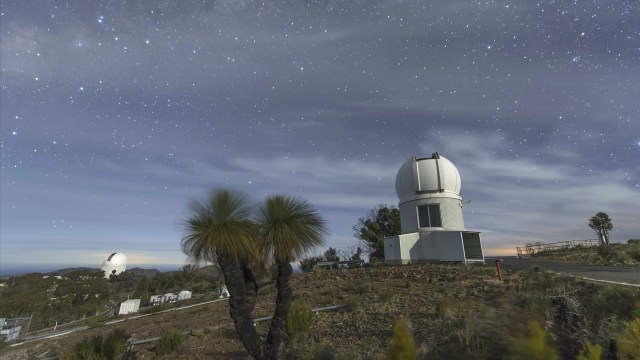
SkyMapper, an automated telescope in northern New South Wales, is building a vast new catalogue of stars and galaxies that are millions of times fainter than the eye can see. Credit: Melbourne Planetarium/Alex Cherney

SkyMapper, an automated telescope in northern New South Wales, is building a vast new catalogue of stars and galaxies that are millions of times fainter than the eye can see. Credit: Melbourne Planetarium/Alex Cherney

The show focuses on two new and innovative Australian telescopes. One is the SkyMapper telescope in Siding Spring Observatory, NSW. This automated telescope is continually scanning the sky, detecting changes as distant objects rapidly brighten or fade away. The sky is a lot more dynamic than we can ever experience for ourselves. The show focuses on SkyMapper’s search for Type 1a supernovae that can help us better understand the mystery of dark energy.

The other telescope is the Murchison Widefield Array (MWA), a radio telescope located in Western Australia. Capturing the Cosmos reveals to the audience the radio sky that the MWA sees. Gone are the usual stars that fill the night sky and instead we see the Milky Way as a bright thin band of hot hydrogen gas, and the tiny dots scattered randomly across the sky are not stars, but distant galaxies. Their bright radio emission is a consequence of each galaxy’s central black hole. The MWA is one of the first telescopes that can peer into the very distant past and help us understand how the first stars and galaxies lit up the universe.

The Murchison Widefield Array beneath the radio sky that the MWA records, this radio telescope detects radio waves that are invisible to our eyes. Credit: Melbourne Planetarium / MWA GLEAM Team / Alex Cherney

The Murchison Widefield Array beneath the radio sky that the MWA records, this radio telescope detects radio waves that are invisible to our eyes.
Credit: Melbourne Planetarium / MWA GLEAM Team / Alex Cherney

Capturing the Cosmos shares the amazing developments that are happening within Australia as astronomers explore the universe from our beautiful southern sky. There are known mysteries that astronomers are working to solve, but these telescopes also have the potential to discover things that will lead to even further questions and mysteries. All-sky astrophysics is leading us towards discovering the true nature of the cosmos.

Posted in Uncategorized | Tagged , , | Leave a comment

APS 2016 Update – Schedule

APS2016

4-5 April

Space Place at Carter Observatory, Wellington, NZ

Milky Way Above Carter Observatory

The Milky Way hangs low over Carter Observatory late one night in Wellington, New Zealand.

It’s now less than a month to this years APS meeting, thanks to everyone who put in a submission and to all those who have registered so far. It’s still not too late, the registration form can be found at APS registration 2016. Alternatively you can register online here.

Updated conference information can be found at APS info 2016_march, and now includes a draft schedule.

Planetarium content is flying in thick and fast so we should have some great stuff to show you.

We look forward to seeing you all in Wellington next month.

Posted in Uncategorized | Leave a comment

APS Early Bird Registration Deadline

APS2016

4-5 April

Space Place at Carter Observatory, Wellington, NZ

Milky Way Above Carter Observatory

The Milky Way hangs low over Carter Observatory late one night in Wellington, New Zealand.

Its hard to believe that its nearly the end of February already, and just 6 weeks to the APS conference. The deadline for Early Bird registration is Monday 29th February, so make sure you get signed up asap.

This is also the deadline for submissions to present at the conference, so if you have something you would like to present then please either drop me an email at Claire.bretherton@wmt.org.nz or, even easier, fill in this quick online form.

You can find further details about APS 2016 at APS info 2016, and the registration form can be found at APS registration 2016. Alternatively you can register online here.

I look forward to seeing you all in Wellington in April.

Posted in Uncategorized | Leave a comment

Mission Complete

*Reprinted on behalf of SciTech

ethan_4_near_space_west_websize

On 3 February 2016, Scitech launched a weather balloon into the stratosphere with a very special mini-astronaut onboard.

The launch was part of Scitech’s ‘Get Your Face Near Space’ competition and the lucky first place winner got their photo stuck onto the mini-astronaut bound for near space.

Perth local Ethan beat 3,500 entrants to win this unique competition and was so excited that, on launch day, the 11-year-old sent a special message to Scitech telling the team how much he was looking forward to seeing himself near space!

After waiting for optimum flight conditions, the Scitech team arrived at Perth Airport at dawn to launch the balloon with the help of the Bureau of Meteorology.

Over the 1.5hrs flight, mini-astronaut Ethan travelled 60km across WA, reached a height of 28km and experienced -50C temperatures.

The retrieval

GPS coordinates told the team that the weather balloon had landed in the Avon Valley National Park.

The Scitech team put their hiking boots on, and after 2.5hrs and 10km of walking through dense bush and on ever diminishing trails, found the equipment and mini-astronaut Ethan safe and sound in a tree.

 The result

This has been a wonderful mission for Scitech and a great success. Through it we have explored the science of weather, space exploration and the joy of maths. We’ve had the privilege of seeing our beautiful state from an astronaut’s point of view and have taken people from Perth, and around the world, on this journey with us.


Posted in Uncategorized | Tagged | Leave a comment