New Dome Arrives in Brisbane

New Dome Arrives in Brisbane

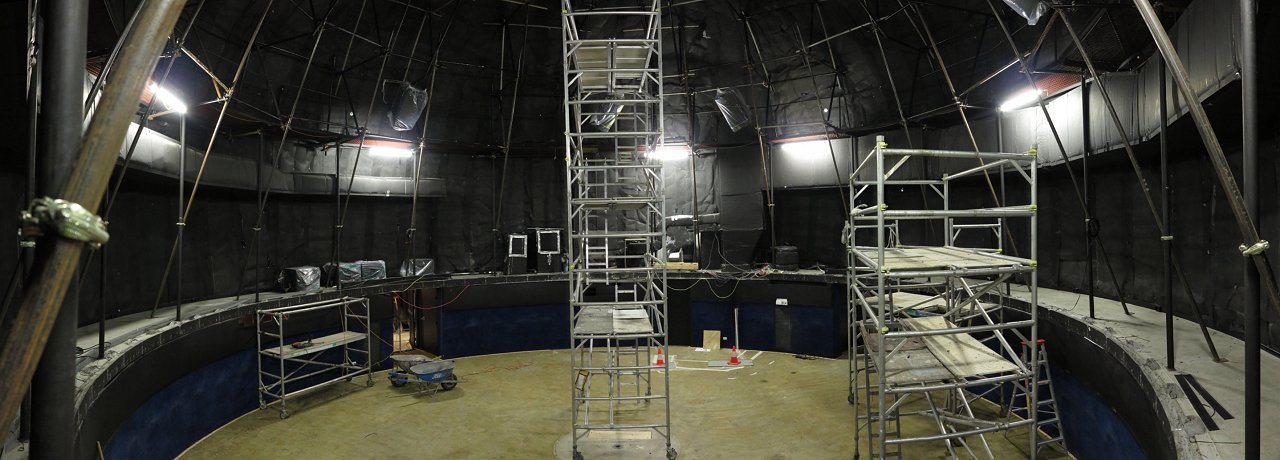
Several tonnes of components for the new custom-made, 12.5-metre diameter projection dome for the Sir Thomas Brisbane Planetarium arrived today from Astro-Tec in Ohio, USA. Assembly began this afternoon. During March, the Cosmic Skydome will be outfitted and new displays installed in other areas. APS 2013 will take place in the upgraded facility on 22/23 April 2013.

Posted in Uncategorized | Tagged , | Leave a comment

Observing the rock 2012 DA14 flying past the Earth on 16 February 2013

The path of asteroid 2012 DA14 across the south-west sky as seen from Sydney on the morning of Saturday 16 February 2013. The times indicated are in AEDT while the positions with relation to the horizon are calculated for 5:00 am. Diagram Nick Lomb

On the morning of 16 February 2013 (Australian time) 2012 DA14, a piece of space rock the size of a large city building, will hurtle past the Earth at a speed of about 28,000 km per hour. Its closest distance to the surface of the Earth will be about 27,700 km, which is closer than any other similar object in modern times. That closest approach is within the paths of the geosynchronous communication satellites that circle at 35,800 km above the equator. However, there is no likelihood of 2012 DA14 hitting the Earth and little chance of a collision with a satellite.

An illustration showing how 2012 DA14 will pass by the Earth and its system of artificial satellites. Courtesy NASA

It will be possible to see and photograph this rare close approach, but from Sydney it will be a little tricky. As the rock is heading for its closest approach rendezvous at 6:26 am AEDT and brightening as it comes closer, the Sydney sky is also brightening with the coming of dawn and sunrise. Any view of the space rock or asteroid is likely to be lost after nautical twilight at 5:34 am when the object’s predicted brightness is 8.2 mag (see discussion on magnitudes below). At closest approach, which almost coincides with sunrise in Sydney, the prediction is for a relatively bright 6.9 mag.

Those who fancy a trip to Adelaide or even to Perth will have a better opportunity to see the flypast at its closest for the Sun rises later there. Of course, as usual with astronomical events the best viewing is from a dark sky site, away from city lights.

For those not familiar with the magnitude scale used by astronomers, it is a measure of the brightness of stars and other objects in the sky. It works in reverse to what you may expect in that the fainter a star the greater its magnitude. Venus, for example, can be magnitude -4, the brightest star has a magnitude of about -1, the faintest star visible from a suburban location maybe magnitude 4, the faintest star visible from a dark location maybe magnitude 6 and with binoculars from a dark sky magnitude 9 maybe visible.

Those in a dark sky should be able to see 2012 DA14 with a pair of binoculars just before dawn. From Sydney suburbs a Go To telescope could be sent to the exact celestial coordinates of the object courtesy of JPL’s Horizons service:

4:00 am AEST RA 10 08 34.75 Dec -76 18 35.2
4:30 am AEST RA 10 29 03.10 Dec -69 26 18.5
5:00 am AEST RA 10 43 14.02 Dec -59 11 15.1
5:30 am AEST RA 10 53 41.53 Dec -43 38 41.4
6:00 am AEST RA 11 01 43.36 Dec -21 21 32.2

For most people though the best way to attempt observation is to set up a camera on a tripod, or better still, a tracking mount pointing in the region of the sky below the Southern Cross and take time exposures during the period between 5:00 and 5:30 am from Sydney (or until local nautical twilight at places to the west of Sydney). If the exposures are long enough the space rock may appear as a faint streak longer than the shorter streaks from stars.

The observations and imaging may not work, but it is still worth trying if the sky is clear. It is a long wait until the next such close pass that we know about, which is that of the asteroid Apophis on 14 April 2029, again in the morning sky. What have you to lose? Only a little bit of sleep!

Nick Lomb

This post has been published simultaneously on the Sydney Observatory blog.

Posted in Uncategorized | Tagged , | Leave a comment

APS 2013 Meeting Change

Image

As work continues at the Sir Thomas Brisbane Planetarium on a major three-month upgrade to many parts of the facility, we have found that we need to re-schedule the APS 2013 Meeting from late March to Monday/Tuesday, 22/23 April 2013. I regret the slip in dates, but it is unavoidable in order to meet obligations for our public opening in the Easter school holidays.

Please note that for the first time, the two-day meeting will not be on a weekend, but we will have the full use of the Cosmic Skydome for the Monday and Tuesday. Sky-Skan has kindly confirmed that they will once again sponsor the APS Dinner for members. Further information will follow next week, including some accommodation suggestions, etc.

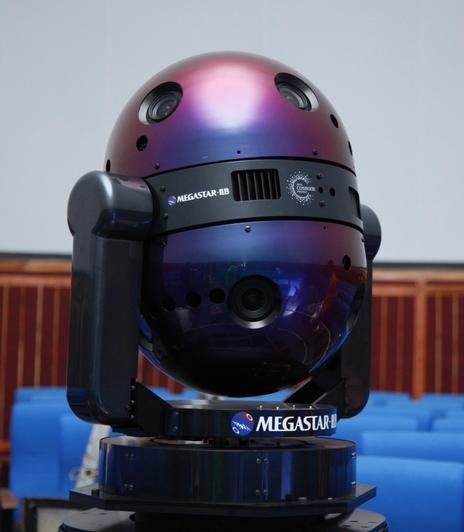
We look forward to seeing many of you here in Brisbane to catch up on news from other members and vendors and see the results of our latest upgrades in the Cosmic Skydome (including only the second Megastar star projector to be installed in the Southern Hemisphere), as well as re-modelling of our foyer, gallery and shop areas.

Mark Rigby
Curator
Sir Thomas Brisbane Planetarium

Posted in Uncategorized | Tagged , | Leave a comment

The Sky Above the First Fleet

The Sky Above the First Fleet

On this Australia Day, think back to the night of Saturday, 26 January 1788. It is recorded that it was clear weather. The sky above the First Fleet at Sydney Cove would have included two bright planets – Jupiter in Taurus (the constellation in which it is currently located) and Mars in Gemini. The Moon, three days past full, would have risen just before 9pm. The constellation of Orion the Hunter and Sirius, the brightest star of the night sky, were also in the sky. The Southern Cross and the Pointer Stars would have been low in the SSE. And no light pollution – dark skies before moonrise. — Mark Rigby

Posted in Uncategorized | Leave a comment

Wambelong Fire (Coonabarabran)

Like me, I’m sure many of you have also been following the fire that went through Siding Spring Observatory and surrounds. It was particularly tough knowing it was almost 10 years ago to the day, that fires destroyed the Mt Stromlo Observatory in Canberra. If Mt Stromlo was the heart of Australian astronomy, surely Siding Spring is its soul.

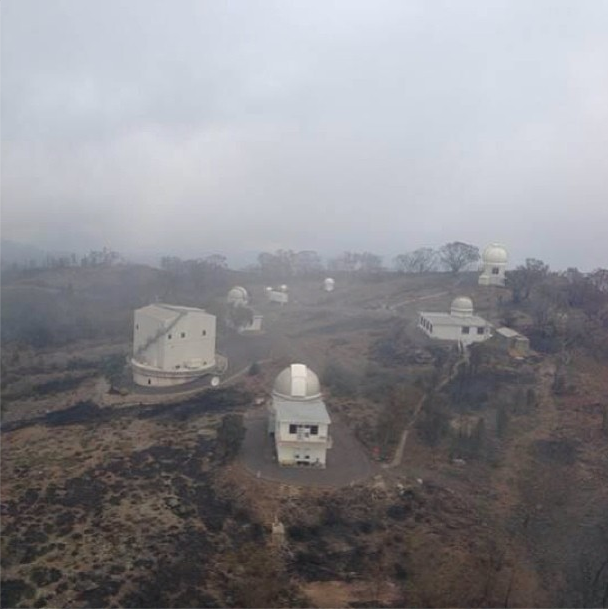
Thankfully, lessons were learnt from that event and it appears that measures put into place may have saved the dozen or so telescopes on the mountain.

However, there has been major damage to the area, with the NSW Rural Fire Service reporting that some 40 properties and over 110 out-buildings have been confirmed lost as well as a large number of livestock and farm machinery. The local wildlife has also been hard hit.

Warrumbungle Shire Council has set up the Warrumbungle Shire Mayor’s Bushfire Appeal to assist residents who have been affected by the fire. As we’ve seen before, it’s such a dreadful thing to have happened. While much praise has been given to the Rural Fire Service for their tireless efforts.

As for the telescopes, here is the latest update from Kate Brooks, President of the Astronomical Society of Australia.

The square "dome" on the left houses the ANU's 2.3 metre telescope which stayed a comfortable 20 degrees throughout the fire. The dome to the top right is the new SkyMapper telescope, led by Nobel Laureate Brian Schmidt and built to continue the work of the Great Melbourne Telescope after it was destroyed in the Mt Stromlo fires. Temperatures there peaked at 65 °C. Source: Rural Fire Services

The square “dome” on the left houses the ANU’s 2.3 metre telescope which stayed a comfortable 20 degrees throughout the fire. The dome to the top right is the new SkyMapper telescope, led by Nobel Laureate Brian Schmidt and built to continue the work of the Great Melbourne Telescope after it was destroyed in the Mt Stromlo fires. Temperatures there peaked at 65 °C. Source: Rural Fire Services

The ANU continue to post updates on the fire damage to Siding Spring Observatory.

A further visual assessment of the SSO site has confirmed:
– 3 buildings have been destroyed (The Lodge, a cottage and a storage building)
– 3 buildings have been badly damaged (The Visitors Centre and two sheds)
– 4 telescopes appear to have some smoke damage to their buildings

A new update on fire damage at the Mopra Telescope is available on the ATNF website.

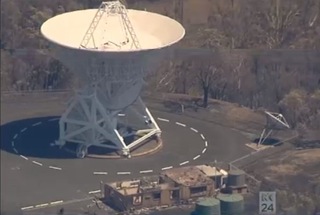
Located down the mountain from SSO, the Mopra Telescope operates at millimetre wavelengths to investigate molecules within star forming regions.

Located down the mountain from SSO, the Mopra Telescope operates at millimetre wavelengths to investigate molecules within star forming regions.

Aerial footage of the Mopra Telescope and a brief first site visit from an SSO staff member on Monday indicated that there was significant fire damage to the onsite control building. This building contained an accommodation area, a control room and an equipment room. From the aerial photo it was clear that the accommodation area was burnt to the ground and yet the concrete roof above the control and equipment rooms appeared relatively intact.

Late yesterday afternoon two CASS staff with an RFS Inspector were able to visit the site and give a brief visual report on the inside of the equipment room. There is smoke damage but the equipment is currently intact with no obvious heat or fire damage. This is very good news. Before the equipment can be tested to see if it is still operational, the structural safety of the building must be assessed and the equipment must be made physically safe.

Amander Bauer, an astronomer at the AAO, continues to do a great job of posting the latest news on her blog.

And you can find some images of SSO during the fire at my post on the Museum Victoria blog.

Posted in Uncategorized | Tagged , , | Leave a comment

State of the Dome

Dome15Jan2013a

Dome15Jan2013b
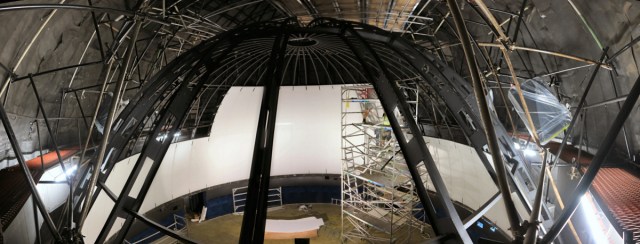
Here are a couple of images from yesterday afternoon showing the state of the Brisbane Planetarium’s Cosmic Skydome a week after closing for major upgrades. All of the seats and floor carpet have gone, along with the console, 12.5m diameter dome and supporting geodesic dome. The structure seen here around the inside is scaffolding installed in 1995 for better access behind the dome. New Layher beams were installed yesterday above the scaffolding and platforms will be installed on them today for future permanent access to the highest levels inside, e.g. access to insulation. Various speakers can be seen sealed in plastic. New concrete work is next on the agenda to bear the support ring for the new dome.

Posted in Uncategorized | Leave a comment

Cosmic Skydome Disassembly Underway

Skydome01

Two hectic days into the Brisbane Planetarium’s shutdown for upgrading the facility, the Cosmic Skydome has been stripped of projectors, LED lighting units, console, much of the cabling, seats and carpet. Displays in the foyer and gallery have been largely dismantled. The removal of the 12.5m projection dome and support structure is next – and involved!

Posted in Uncategorized | Leave a comment

Recent Brisbane Planetarium News

Coral01Apart from being busy preparing for the biggest upgrade since the opening of the Sir Thomas Brisbane Planetarium in 1978, Planetarium staff members were involved for the first time in the Brisbane International Film Festival during late November on a Friday night and a Saturday afternoon. Both sessions were sold out. Thanks are due to Warik Lawrance and Melbourne Planetarium for slicing the content for the Friday night.

Posted in Uncategorized | Tagged , | 2 Comments

Brisbane Planetarium Upgrade

STBP mega-pano 4 - screen

The Sir Thomas Brisbane Planetarium will be closing from Wednesday, 9 January 2013 and re-opening to the public on Easter Saturday, 30 March 2013. During this time, the Planetarium’s Cosmic Skydome projection dome will be replaced, a Megastar-IIB optical star projector and new console added, new projectors installed for the digital system, computers upgraded, seats refurbished and carpet replaced. The foyer, gallery and shop also will undergo major changes. APS members will receive a preview of all of this at APS 2013, which will be held on 23/24 March 2013.   N.B. APS 2013 has now been moved to 22/23 April.

Posted in Uncategorized | Tagged , , | 1 Comment

Tycho is back

Tycho in the shop

It is with great delight that we can announce that Tycho has returned to the Scienceworks gift shop.   It has been quite a few years since a Tycho soft toy was available.  Many of the original soft toy Tychos were given away at the 2006 IPS in Melbourne and they have become quite rare since then. 

The new Tycho soft toy has poseable legs and ears, is fun to play with and cuddly to boot.  Welcome back Tycho!

Posted in Uncategorized | Tagged , , | 1 Comment