Brisbane Planetarium

After almost three hectic months of being closed for upgrades (including more disruptive major weather events), the Sir Thomas Brisbane Planetarium opened to crowds on Saturday, 30 March 2013.

We received very good media coverage, including a long prime-time ABC TV news segment in the evening and TV coverage on Thursday night on Ten, radio.

We hope that as many of you as possible will be able to attend APS 2013 here in the Brisbane Planetarium in just three weeks and experience our new upgrades.

Below in no particular order are some of the changes in the Brisbane Planetarium:

  • We gutted our Cosmic Skydome and displays areas.
  • Installed new displays in the foyer and gallery, as well as re-doing our shop – all look much improved.
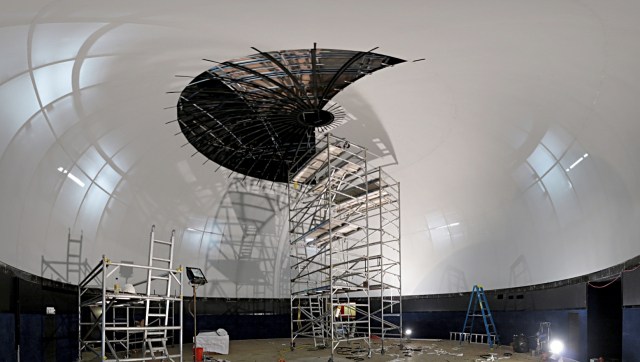
  • Installed a new 12.5-m diameter Astro-Tec dome with a reflectivity of 44% versus the 35-year-old Zeiss dome’s 70% (better for the fulldome content). Less than one third of the number of panels as well.
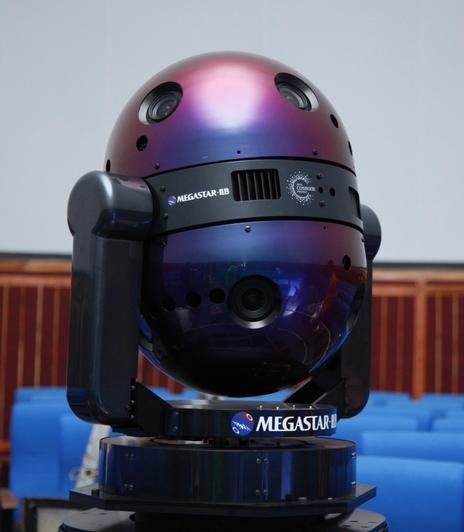
  • Installed the new Ohira Tech Megastar-IIB optical star projector (the first IIB model in the southern hemisphere and only the second Megastar in this hemisphere – there is a IIA model in Buenos Aires).
  • Sky-Skan, which acted as overall prime contractor for the Skydome equipment and dome upgrades, including further improvements to their digital system installed in 2010, also built to our specific requirements a special lift for the Megastar and designed a new console. We also now have the addition of a manual panel for Sky-Skan’s DigitalSky control – so we have the choice of multiple interfaces, including keyboard and/or mouse. Sky-Skan has improved our software and loaded GIS data sets for Earth, the Moon and Mars. We also have scheduled further improvements before the end of the financial year in June.
  • We sent our seats out for re-covering and increased the number by five to 133; wheelchair spaces have increased from three to five. Seating is now colour-coded to accommodate both omni-directional or uni-directional shows.
  • We re-carpeted the Cosmic Skydome, including all the way up to the new lower profile LED lighting cove just below the springline. The old big coves are now gone and it looks so much better.

Mark Rigby
Curator, Sir Thomas Brisbane Planetarium

Posted in Uncategorized | 1 Comment

Colourful domes

I have provided more details on planetarium/dome activity in 2012 in a written report that will be available at the APS 2013. But some might enjoy the following … you may be aware I on occasion do installation work in planetariums and museums, just a hobby really. But looking back on 2012 I did 6 planetariums installs, don’t know where I found the time! Some photos below, click for higher resolution version.

aps

I use to think the Sri Sathya Sai Space Theatre (bottom image above) was one of the more colourful/unique planetarium dome exteriors but it has now been easily surpassed by the following. Not small at 12m diameter.

Parshuram_1

The character is Bhagwan Parashuram, 2 stories tall, the 6th incarnation of Vishnu who appears when the planet is in great danger. “…is considered by religious scholars to relieve the earth’s burden by exterminating the sinful, destructive and irreligious monarchs that pillaged its resources, and neglect their duties as kings.”.

Be warned!

Posted in Uncategorized | Leave a comment

APS 2013 Meeting

The APS 2013 is rapidly approaching and promises to be a busy, hectic and fruitful meeting.  It will take place at the upgraded Sir Thomas Brisbane Planetarium on the 22nd & 23rd of April.  Mark Rigby has done a terrific job of putting together a jam-packed program, which you can download here:  APS 2013 Program

This will be an excellent opportunity to see a huge range on new content, new planetarium software and hardware and network with other planetarians.  Please make sure you can attend, it will be great to see you there.

Posted in Uncategorized | Tagged , | Leave a comment

Almost to the Top!

Almost to the Top!

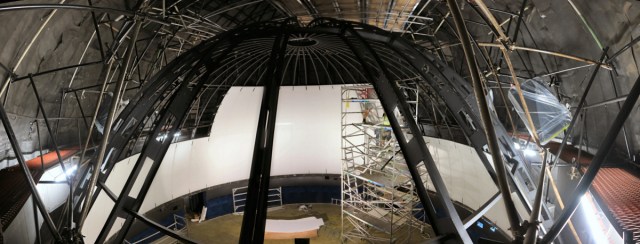
Here’s the Brisbane Planetarium’s new dome with the third level of panels going in as of the evening of Saturday, 16 February 2013. No work is being done on the dome itself today, so attention is being give to the new light cove to be installed at the base of the dome for all the LED lighting units.

Posted in Uncategorized | Tagged , | Leave a comment

Brisbane Planetarium Panels Going Up

Brisbane Planetarium Panels Going Up

Panel installation is well underway for the Sir Thomas Brisbane Planetarium’s 12.5-metre projection dome. This image was taken earlier today showing the beginning of the second layer of panels going up. There are 36 panels in each of three layers and then a cap at the top. Painting with a 44% reflectivity paint will follow.

Posted in Uncategorized | Tagged , | 2 Comments

Congratulations to Nick Lomb

Well deserved award to our friend Nick Lomb for his jointly shared 2012 Museums and Galleries NSW individual achievement award recognising Nick’s work as curator of astronomy, horology, meteorology and surveying for Sydney Observatory and the Powerhouse Museum over a period spanning more than 32 years. Further details.

Posted in Uncategorized | Tagged , | 1 Comment

Brisbane Planetarium Dome Progress

Brisbane Planetarium Dome Progress

The 36 support ribs have now been installed in the Sir Thomas Brisbane Planetarium’s Cosmic Skydome. Commencing next week, 109 aluminium panels will be installed on the ribs to form the new Astro-Tec 12.5-metre diameter dome replacing the 35-year-old Zeiss dome. You can see the result during APS 2013 being held in Brisbane over Mon/Tue, 22/23 April.

Posted in Uncategorized | Tagged , | Leave a comment

New Dome Arrives in Brisbane

New Dome Arrives in Brisbane

Several tonnes of components for the new custom-made, 12.5-metre diameter projection dome for the Sir Thomas Brisbane Planetarium arrived today from Astro-Tec in Ohio, USA. Assembly began this afternoon. During March, the Cosmic Skydome will be outfitted and new displays installed in other areas. APS 2013 will take place in the upgraded facility on 22/23 April 2013.
Posted in Uncategorized | Tagged , | Leave a comment

Observing the rock 2012 DA14 flying past the Earth on 16 February 2013

The path of asteroid 2012 DA14 across the south-west sky as seen from Sydney on the morning of Saturday 16 February 2013. The times indicated are in AEDT while the positions with relation to the horizon are calculated for 5:00 am. Diagram Nick Lomb

On the morning of 16 February 2013 (Australian time) 2012 DA14, a piece of space rock the size of a large city building, will hurtle past the Earth at a speed of about 28,000 km per hour. Its closest distance to the surface of the Earth will be about 27,700 km, which is closer than any other similar object in modern times. That closest approach is within the paths of the geosynchronous communication satellites that circle at 35,800 km above the equator. However, there is no likelihood of 2012 DA14 hitting the Earth and little chance of a collision with a satellite.

An illustration showing how 2012 DA14 will pass by the Earth and its system of artificial satellites. Courtesy NASA

It will be possible to see and photograph this rare close approach, but from Sydney it will be a little tricky. As the rock is heading for its closest approach rendezvous at 6:26 am AEDT and brightening as it comes closer, the Sydney sky is also brightening with the coming of dawn and sunrise. Any view of the space rock or asteroid is likely to be lost after nautical twilight at 5:34 am when the object’s predicted brightness is 8.2 mag (see discussion on magnitudes below). At closest approach, which almost coincides with sunrise in Sydney, the prediction is for a relatively bright 6.9 mag.

Those who fancy a trip to Adelaide or even to Perth will have a better opportunity to see the flypast at its closest for the Sun rises later there. Of course, as usual with astronomical events the best viewing is from a dark sky site, away from city lights.

For those not familiar with the magnitude scale used by astronomers, it is a measure of the brightness of stars and other objects in the sky. It works in reverse to what you may expect in that the fainter a star the greater its magnitude. Venus, for example, can be magnitude -4, the brightest star has a magnitude of about -1, the faintest star visible from a suburban location maybe magnitude 4, the faintest star visible from a dark location maybe magnitude 6 and with binoculars from a dark sky magnitude 9 maybe visible.

Those in a dark sky should be able to see 2012 DA14 with a pair of binoculars just before dawn. From Sydney suburbs a Go To telescope could be sent to the exact celestial coordinates of the object courtesy of JPL’s Horizons service:

4:00 am AEST RA 10 08 34.75 Dec -76 18 35.2
4:30 am AEST RA 10 29 03.10 Dec -69 26 18.5
5:00 am AEST RA 10 43 14.02 Dec -59 11 15.1
5:30 am AEST RA 10 53 41.53 Dec -43 38 41.4
6:00 am AEST RA 11 01 43.36 Dec -21 21 32.2

For most people though the best way to attempt observation is to set up a camera on a tripod, or better still, a tracking mount pointing in the region of the sky below the Southern Cross and take time exposures during the period between 5:00 and 5:30 am from Sydney (or until local nautical twilight at places to the west of Sydney). If the exposures are long enough the space rock may appear as a faint streak longer than the shorter streaks from stars.

The observations and imaging may not work, but it is still worth trying if the sky is clear. It is a long wait until the next such close pass that we know about, which is that of the asteroid Apophis on 14 April 2029, again in the morning sky. What have you to lose? Only a little bit of sleep!

Nick Lomb

This post has been published simultaneously on the Sydney Observatory blog.

Posted in Uncategorized | Tagged , | Leave a comment

APS 2013 Meeting Change

Image

As work continues at the Sir Thomas Brisbane Planetarium on a major three-month upgrade to many parts of the facility, we have found that we need to re-schedule the APS 2013 Meeting from late March to Monday/Tuesday, 22/23 April 2013. I regret the slip in dates, but it is unavoidable in order to meet obligations for our public opening in the Easter school holidays.

Please note that for the first time, the two-day meeting will not be on a weekend, but we will have the full use of the Cosmic Skydome for the Monday and Tuesday. Sky-Skan has kindly confirmed that they will once again sponsor the APS Dinner for members. Further information will follow next week, including some accommodation suggestions, etc.

We look forward to seeing many of you here in Brisbane to catch up on news from other members and vendors and see the results of our latest upgrades in the Cosmic Skydome (including only the second Megastar star projector to be installed in the Southern Hemisphere), as well as re-modelling of our foyer, gallery and shop areas.

Mark Rigby
Curator
Sir Thomas Brisbane Planetarium

Posted in Uncategorized | Tagged , | Leave a comment